YES! Recommends: Dream of a Nation

From YES! Magazine for teachers:
A Powerful Free Resource for Teachers and Professors

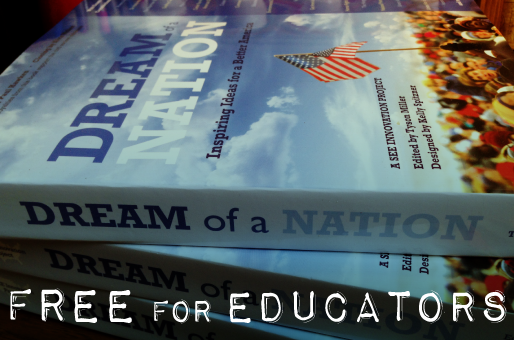
Dream of a Nation reaches across political party lines and religious beliefs and focuses on what we have in common, what is possible.It is comprised of a book and an initiative, with special focus on providing educators with hands-on, standards based, spot on lesson modules. Essays, video clips, and guides are designed to flip the switch from toe-dipper to full-on, change-the-world citizens.

The book’s 12 chapters explores contemporary problems, new ideas, and successful models. Its stellar collection of essays and illustrations are authored by more than 60 individuals and organizations, such as YES! Magazine, Veterans for Peace, and Green for All.

Dream of a Nation is proud to create and offer an array of free, downloadable materials for educators, including:

The book’s 12 chapters explores contemporary problems, new ideas, and successful models. Over 60 individuals and organizations, including YES! Magazine, Veterans for Peace, and Green for All, authored this stellar collection of essays and illustrations.
You may download the book in its entirety or individual chapters here

Four lesson modules with 18 lesson plans take your students from becoming issue experts to being active in their communities. In addition, robust questions for each chapter of the book are offered. Your students will debate, connect problems with solutions, discover opposing points of view, and hatch their own plans to take action on the issues they care about. No sitting on the sidelines, here!

For each of the 12 overarching issues (chapters), at least four related issues are identified and explored. Essays authored by partner organizations about their efforts to address the challenge help connect your student with the real world. “What If?” and “What Can I Do?” questions deepen understanding and inspire students to action. Explore solutions here.

Dream of a Nation isn’t a textbook. It focuses on real-world examples and content to support goals and standards that students are required to master, and teachers are required to teach.

The book and all curriculum materials align with Common Core Standards, National Council for the Social Studies Curriculum Standards, as well as standards requirements as described by state education agencies. Visit standards alignment here

Additional Resources

Educators :: Home page for entire collection of free, downloadable curriculum resources.

Secondary Education Portal ::  Access to all downloads, forums, blogs, and action center.

Higher Education Portal ::  Access to downloads, forums, blogs, and action center.


billboard

Getting Extreme Profits Out of Healthcare

With the choice of Representative Paul Ryan Healthcare and Medicare have been thrust back into the headlines, and rightfully so. Healthcare consumes 17 percent of our gross domestic product, about $7,100 per person. This is nearly twice as much money per capita on healthcare as other developed nations, yet the metrics show that Americans end up with worse care and poorer health.

The Affordable Care Act is a step in the right direction, but only a minor one. By the time it is fully implemented in 2014, it will have increased access to healthcare for millions of Americans, but it will have done little to rein in costs. In theory, cost controls should be a goal that Republicans and Democrats can agree on, yet it will be an even bigger political battle than the previous one over access. That’s because to rein in costs it will not be possible to tinker around the edges of a broken system, as the 2010 healthcare reform did. It will be necessary to fundamentally overhaul the system in ways that powerful special interests will fight.

What’s driving up the cost? Extreme profits. In virtually every other health system, health insurance companies are non-profits – they have no incentive to drive up costs – and they use negotiate standard fees for various procedures. As healthcare costs continue to spiral out of control, it’s clear that we can no longer stand to be the exception to the rule to protect the profits of a handful of individuals.

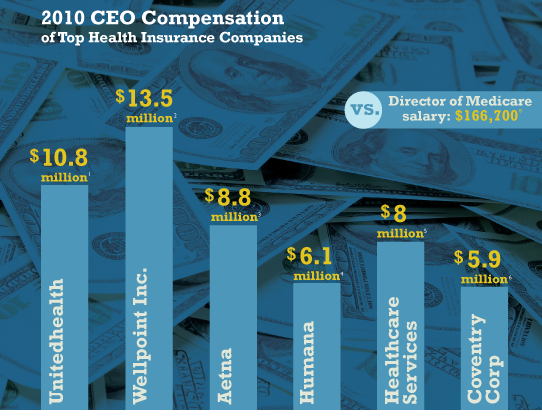
It’s difficult to fathom why insurance premiums continue to rise and coverage shrinks, while some CEOs take home many millions of dollars a year.

One glimmer of hope is the announcement by Blue Shield of California, a non-profit and one of the top ten health insurance providers. After public outcries about premiums and executive compensation, the organization promised to refund $167 million to customers and cap future profits.

Other insurance companies will be required to follow suit. The Affordable Care Act requires insurers to spend at least 80 percent of their revenue on medical care, leaving 20 percent for administrative costs, including salaries and profits. Insurers that don’t meet that target will be required to issue refunds to policyholders.

This is tiny piece of the puzzle, but one of the many pieces being lost in the current heated debate.  It’s not easy debating complicated issues, but we as the American people need to be diligent about talking about what’s really at stake.  Learn more about how other countries are getting it right and scalable solutions from Stephen Hill’s essay Getting Extreme Profits Out of Healthcare.

Getting Money Out of Politics

With the elections just around the corner, it’s hard not to see just how powerful a role that money plays in politics. Fortunately there are organizations and others working to tackle this important issue and a light at the end of the tunnel.

Too often federal elections end up as fundraising contests, instead of a conversation about the issues our country faces. 9 out of 10 campaigns are won by the candidate who spends the most, which drives candidates to focus more on fundraising and large donors than on mobilizing voters around ideas and issues.

Under one half of 1% (0.36%) of the American population currently donates over $200 to political campaigns. This small, wealthy minority provides around 90% of the money that funds political campaigns. This extreme imbalance of influence inhibits the idea of government as being accessible to all people.

At times it feels like the money-fueled system is impossible to change, especially with the effects of Citizen United and the Super PACs that were born of it blaring from all directions. Fortunately, several states and local communities have discovered a solution by reforming campaign finance with the Fair Elections model. In 2008, Connecticut became the first state to have Fair Elections public financing passed by the legislature. Within just a couple years, 81 percent of the Connecticut legislature was made up of politicians who used the system. Current Secretary of Homeland Security, Janet Napolitano, sought and won Arizona’s governorship twice using a Fair Elections– style public finance system.

Voters like public funding because it makes elected officials more accountable to them, reduces conflicts of interest and gives them more choice at the polls. Though a small step, this is one solution to a problem that the American people are increasingly getting fed up with. It’s time to get money out of politics, and get back to focusing on people and the fundamentals of good governance.

Read more about the problem and solutions here in Common Cause’s essay from Dream of a Nation“Getting Money Out of Politics: Putting the Public First.”

Dream of a Nation– Realizing Our Full Potential, Together

“When the story of these times gets written, we want it to say that we did all we could, and it was more than anyone could have imagined.” – Bono

This is the week of the birth of America, one of the wildest and most amazing experiments in modern history. We thought this would be the perfect week to start a conversation, a conversation about where we are as a nation and where we could be, if we come together.

It has been said that what we focus on tends to expand and if this is indeed true, then we need to devote a lot more time to exploring solutions. Solutions that are inclusive, out-of-the box and grounded in a shared devotion to each other and future generations. In a partnership with Living Green Magazine over the coming months, we will be sharing solutions and stories from Dream of a Nation – a citizen’s handbook, web platform, and educators’ resource that dives into a wide spectrum of issues.

We worked for nearly 3 years with over 60 pioneering organizations and thought leaders with positive visions and blueprints for the future from Alice Walker and Hopi Elder Mona Polacca to Geoffrey Canada and Veterans for Peace to Union of Concerned Scientists and the Citizen Effect, and many many more.

Many of the problems and related solutions that we face are interconnected. As we re-prioritize the nearly $700 billion that we spend on the military, for example, it frees up resources for education, healthcare, job creation and building the green economy. As we support local living economies, it prevents the off-shoring of opportunity and serves to reduce the growing economic divide. As the news media focuses more on constructive journalism and solutions, the spirit of collaboration is bolstered. As citizens are further empowered, communities across the land and democracy are strengthened.

Paul Hawken has said, “Inspiration is not garnered from the litanies of what may befall us; it resides in humanity’s willingness to restore, redress, reform, rebuild, recover, reimagine and reconsider.” In a sense, this is what Dream of a Nation explores, and what we will dive into here in Living Green Magazine. The dreams of ordinary citizens and visionaries are what have made and still make this great country of ours. Ultimately, in this shared and ever-evolving society, our greatest strength lies in our ability to work together toward a collective purpose that is grounded in our common humanity.

Thankfully, it is ordinary people doing extraordinary things who are keeping the flame alive and charting a different path for our future. They are students and CEOs, political leaders and artists, entrepreneurs and teachers, volunteers and big-thinkers who are rooted in creativity, positivity and hope.

We are excited to be sharing inspiring and empowering stories in the coming months and wish you a Happy Independence Day!

Eco Etiquette: Is ‘Made In America’ Better For The Environment?

A wonderful article by Jennifer Grayson about American manufacturing.  She refers to Dream of a Nation as  “a new book that should be on every environmentalist’s — heck, every American’s reading list.” Aw shucks!


Eco Etiquette: Is ‘Made In America’ Better For The Environment?     By Jennifer Grayson, HuffPost’s Miss Eco Etiquette. Editor, The Red, White and Green. (Published on the Huffington Post)

I was shopping with my friend the other day, and she said she tries to buy American-made products whenever possible. From a green perspective, is this a good thing? I mean, what if it’s between organic sheets made in China and regular ones made in the US?

-Jennie

…We will not go back to an economy weakened by outsourcing, bad debt, and phony financial profits. Tonight, I want to speak about how we move forward and lay out a blueprint for an economy that’s built to last, an economy built on American manufacturing, American energy, skills for American workers, and a renewal of American values.

This blueprint begins with American manufacturing.

The President’s State of the Union address Tuesday night, which included his declaration above, was a rousing call to action not only for American companies to reinvest in homegrown skilled workers, but for anyone who’s ever felt a pang of guilt at the “made in China” tag on the back of a recently purchased T-shirt.

With some 5.6 million Americans still unemployed, creating incentives for US companies to move jobs back home will undoubtedly support the economy. So will buying American products: As ABC News has touted in its popular Made in America series, spending just $64 more than usual on US-made goods would create 200,000 jobs.

But what about supporting the eco-nomy? Does buying American-made also help the environment, as your friend suggests?

As a general rule, I believe it does. When you choose products manufactured here at home, you avoid the extra fuel expense of shipping foreign-made goods halfway around the globe. Those fuel costs are significant, considering that nearly 60 percent of everything we buy now is imported.

Then, too, there’s the issue of the poor environmental standards in overseas factories that have given us lead in children’s toys and melamine in dog food. In 2005, the Chinese Ministry of Health estimated that 200 million Chinese workers were regularly exposed to toxic chemicals. That same year, 386,645 workers died as a result of occupational illnesses.

Those statistics are appalling; similar occurrences would be unimaginable in American factories, where we have laws (and ahem, government regulation) in place to protect our workers and our natural resources. So by buying American-made, you’re ostensibly supporting a cleaner, safer environment.

I could also spend the rest of this article calculating the potentially minimized land and water use involved in the making and transporting of the conventional cotton sheets versus the shipping-related fuel costs of the Chinese-made organic cotton ones, not to mention the recyclability of their PVC packaging. But such minutiae is missing the point.

I say, buy the American sheets and move on, because we need to talk about the bigger opportunity here, which is: Where we can focus our American manufacturing and purchasing efforts to have the biggest impact on the environment and our economy.

The answer is: Our infrastructure.

President Obama didn’t make this connection in his speech (infrastructure was mentioned later, in the context of jobs), but a new book that should be on every environmentalist’s — heck, every American’s — reading list does.

The book is a collection of essays called Dream of a Nation, and much like the President’s speech, it calls on us to come together as Americans in our work toward a sustainable future. Edited by Tyson Miller, each essay posits an innovative — but eminently doable — solution to our country’s most challenging problems.

One essay, aptly named “Make It in America” (by Campaign for America’s Future‘s Eric Lotke), raises a crucial point: If we’re going to rebuild our crumbling roads and bridges, it’s not enough to do it with American workers — we need to do it with American parts.

Sound obvious? It’s not. Lotke explains that while nations like Canada and the EU (and yes, even China) actively source home-manufactured products for their public projects — even writing it into their trade agreements — the US does not.

This is preposterous. Why are we importing Chinese steel modules to build American bridges (as was the case in the recent reconstruction of the San Francisco-Oakland Bay Bridge), when we could make them in America and create even more much-needed jobs here at home?

Why not make those parts here, where we can oversee the environmental conditions under which they were created, and account for their quality?

If the American parts companies either don’t yet exist or aren’t up to speed to produce the materials we need for these projects, we’ll just have to create them or invest in their retooling, generating more American jobs in the process.

Of course, the Great Green Hope of making anything in America would include — as Obama highlighted in his address — the realization of our own clean energy economy. Completing the circle, that would mean bridges assembled by American workers, using products built in American factories that are powered by American-harnessed wind or solar power.

For now, it’s the dream of a nation. But as the President laid out for the American people, the blueprint is there. We just have to follow it.

Follow Jennifer Grayson on Twitter: www.twitter.com/jennigrayson


From the Huffington Post